
When Getting Diagnosed Made Everything Worse
The unmasking regression no one warns you about.

Getting diagnosed with ADHD should make things easier.
Instead, you can’t function at all.
You’ve forgotten your kid’s parents’ evening. Missed work deadlines. Snapped at your partner. The house is a disaster.
Six weeks ago, you were holding it together—exhausting, fragile, but functional. Now you’re falling apart.
Everyone says diagnosis is supposed to help. So why does everything feel worse?
Here’s what’s actually happening: you’re not getting worse. You’re stopping.
And that difference changes everything.
When the Scaffolding Collapses
Three weeks after diagnosis, Michael sat at his kitchen table at 11 pm, staring at a pile of unopened post that had been growing for a month.
This was new.
He’d always managed the admin—always. It was exhausting and required elaborate systems and multiple alarms, but he did it.
Now he couldn’t even open a letter from the council.
What had changed? He had a diagnosis. Medication. Answers.
Shouldn’t everything be easier?

The Panic No One Warns You About
In clinic last month, a patient told me she’d made a terrible mistake getting diagnosed.
She’d been coping fine for 38 years—demanding job, two kids, messy house, but functional life.
Six weeks post-diagnosis, she’d forgotten her daughter’s parents’ evening, missed two work deadlines, and snapped at her husband so badly he’d slept in the spare room.
“I think the diagnosis broke me,” she said.
I recognised that fear. In myself, after diagnosis as an adult. And I see it constantly now—this panicked realisation that diagnosis hasn’t fixed anything.
It’s made everything harder.
What’s Actually Collapsing
Before diagnosis, many of us develop what I think of as “compensatory overdrive”—a state of chronic hypervigilance and overcompensation that we mistake for just how life is.
We’re constantly busy because stillness feels unbearable.
We say yes to everything because we’ve learned that staying indispensable keeps criticism at bay.
We maintain elaborate systems because we know—at some level we can’t quite articulate—that without them, we’ll be exposed as frauds.
This isn’t sustainable. But it can last for years, sometimes decades, before something shifts.
Often, that something is diagnosis.
Suddenly, you have permission to ask: Why am I doing all of this?
And that question opens a void.
The job that kept you frantically engaged? You realise you took it because it looked impressive, not because you wanted it.
The social commitments filling your calendar? Obligations you agreed to out of people-pleasing, not genuine interest.
The person you’ve been performing for friends and colleagues? A mask you’re suddenly, desperately tired of wearing.
What looks like regression is actually the removal of scaffolding you didn’t know was holding you up.

Why Unmasking Feels Like Collapse
There’s a clinical pattern I notice repeatedly: high-functioning adults who’ve spent years compensating suddenly can’t function at all after diagnosis.
The mechanisms are clearer than they might appear.
First, there’s selective attention.
Once you know you have ADHD, you start noticing every forgotten appointment, every misplaced key, every emotional overreaction.
Things that happened before diagnosis now carry new significance.
You’re not forgetting more—you’re noticing it more.
Second, there’s permission to struggle.
Before diagnosis, you had no choice but to push through.
Now there’s this small voice asking, “Should I even be trying to do things this way?”
That question—however valid—creates hesitation where there used to be automatic (if exhausting) action.
Third, and perhaps most significant, there’s unlearning.
The coping mechanisms you developed weren’t healthy, but they were functional.
This shows up everywhere—in how we manage emotional dysregulation, in our relationship patterns, even in how we structure our workdays.
Being constantly busy kept your ADHD brain engaged.
Saying yes to everything meant you never had to confront what you actually wanted.
Performing normality avoided uncomfortable conversations about accommodation.
Diagnosis invites you to try something different. But different is terrifying when you don’t yet know what it looks like.
Quick gut check: How many months post-diagnosis are you? And what’s the thing you used to handle effortlessly that now feels impossible?
Drop it below—I’m tracking patterns.
The Void Isn’t Emptiness
Here’s what I wish someone had told Michael during those first overwhelming months—something that would have stopped him staring at that pile of post at midnight, convinced he’d made a terrible mistake:
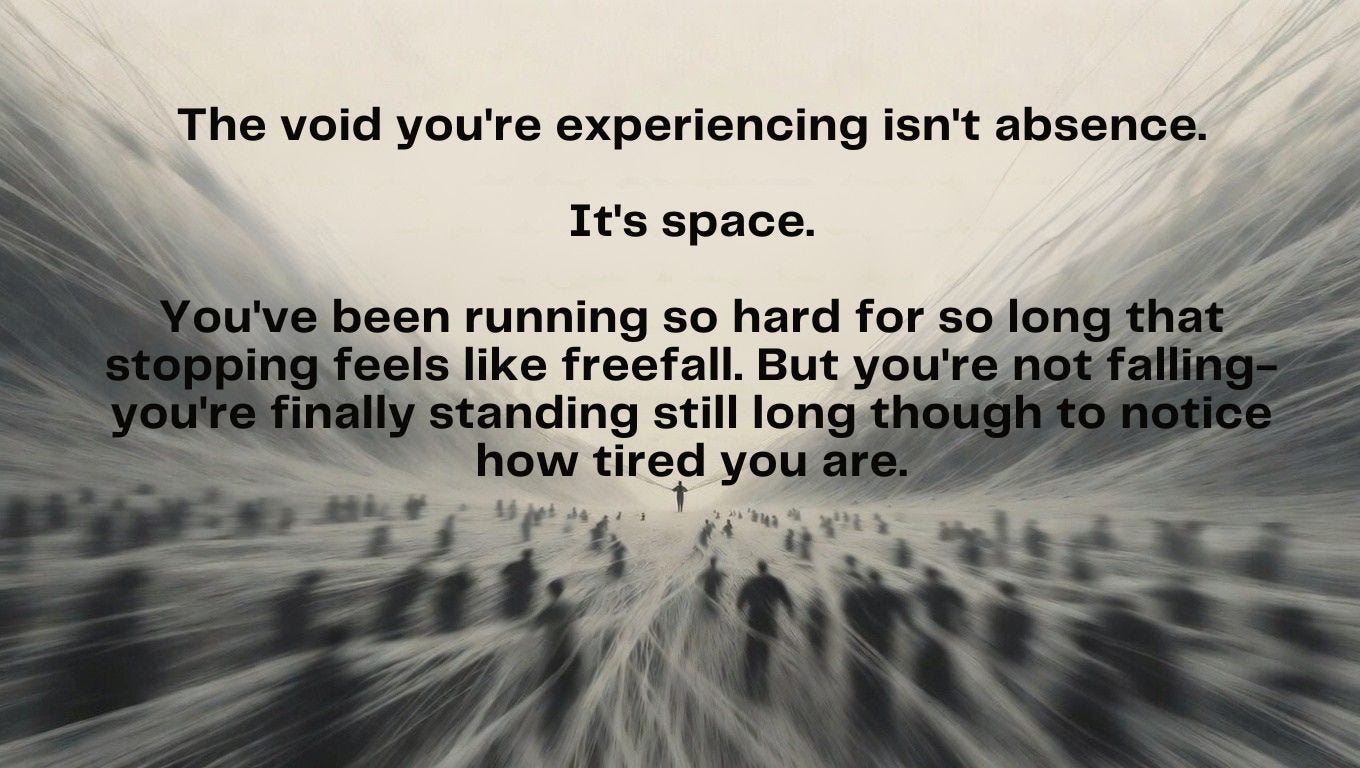
If this just described your last six weeks, restack it. Someone in your network is convinced they’ve broken themselves. Show them they haven’t.
When my patient said diagnosis had broken her, what she meant was: “I can’t keep doing things the old way, but I don’t know a new way yet.”
That’s not broken. That’s transition.
The forgotten parents’ evening? She’d been managing an impossible mental load through sheer force of will.
Now she was questioning whether she needed to be on the PTA committee, manage the school WhatsApp group, and volunteer for every bake sale.
The questioning created friction.
The friction looked like forgetting.
The work deadlines? She’d been staying late every night, compensating for ADHD time-blindness through anxiety-fuelled overwork.
Now she was considering whether constant overtime was actually sustainable.
The consideration created resistance.
The resistance looked like failure.
The argument with her husband? She’d been suppressing irritation for years, believing her emotional responses were inappropriate.
Now she was learning that some of her needs were legitimate.
The learning created conflict.
The conflict looked like dysfunction.
What Unlearning Actually Requires
I won’t pretend this is straightforward.
Developing new ways of managing time, emotions, and energy when your brain works differently—that takes practice, patience and often substantial support.
What helped Michael wasn’t a system or a strategy.
It was recognising that he wasn’t passively deteriorating—he was actively dismantling patterns that no longer served him.
Exhausting, disorienting, purposeful.
And giving himself permission to be absolutely terrible at the new approaches.
The old way was familiar. The new way felt clumsy, awkward, and inefficient for months.
That wasn’t failing. That was learning.
But here’s what he had to do first: identify what he’d been compensating for.
He was using busyness to manage ADHD-related boredom sensitivity.
Once he understood that, he could find less destructive ways to keep his brain engaged.
But he had to stop being busy first to notice the pattern.
The workplace version of this is what I've called the Goodwill Clock—that window where colleagues are patient with your adjustments before their tolerance runs out.
Most people need support for this transition. Therapy. ADHD coaching. Honest conversations with partners or managers about what’s shifting.
Michael needed all of these things, though he resisted admitting it for months.
The Other Side of Regression
Six months after diagnosis, Michael was still struggling with the post.
But he’d stopped agreeing to committees he didn’t want to be on.
He’d reduced his working days from five to four.
He’d started running again—something he’d abandoned years earlier because it “wasn’t productive.”
A year later, the admin still wasn’t perfect. But he’d learned to ask his manager for help instead of staying late to handle everything himself.
He’d stopped performing the version of “responsible professional” that required him to be constantly available and never uncertain.
Two years later, I noticed something unexpected: he was working less but achieving more.
Because he’d finally stopped trying to operate like someone whose brain worked completely differently from his own.
The regression people experience post-diagnosis isn’t the beginning of decline. It’s the uncomfortable middle stage between unsustainable compensation and sustainable adaptation.
What comes after—if you can tolerate the discomfort long enough to get there—isn’t a return to how things were.
It’s something genuinely new.
If You’re In The Void Right Now
You might be reading this a few weeks or months post-diagnosis, feeling like everything is harder than it should be.
Like you’ve made a mistake.
Like you were actually fine before, and now you’ve broken something fundamental.
Let me tell you what I see from the other side: you weren’t fine before.
You were performing fine while slowly burning out.
Diagnosis didn’t break you—it revealed how much effort you were expending just to appear functional.
That revelation is painful. It’s meant to be.
You can’t build something sustainable on a foundation of chronic overcompensation.
The void you’re in isn’t permanent. But it’s also not optional.
You have to go through the unlearning to get to something better.
And better is possible.
Not perfect—I still see patients who forget things and struggle with admin and occasionally say yes to commitments they’ll later regret.
But they’re not exhausted all the time anymore.
They’re not constantly braced for criticism.
They can tell the difference between their actual limitations and the ones they’ve internalised from years of trying to be someone they’re not.
That difference? That’s what makes the regression worth it.
Tell me in the comments: what stopped working after diagnosis? One word. I’m reading every single one.
And if someone you know is in the void right now—forward this. They need to hear they’re not broken.
This is part 1 of a 2-part series on post-diagnosis adjustment. Next week: “The Goodwill Clock at Home”—your partner was patient for three months. Now they’re exhausted. Here’s why the Goodwill Clock runs faster at home than it ever did at work, and what to do when it runs out.
Subscribe so you don’t miss it. Early subscribers shape where this newsletter goes—reply and tell me what you’re actually struggling with post-diagnosis.
Oh boy, I was diagnosed as autistic at 44 (46 adhd) and this is exactly what occurred. I thought I knew enough to not do this and that I could manage and control this change. I didn’t - I did go on an adhd med and for me that helped get over some of the hump from wanting to do something to actually doing it (but not every time and not like magic). I’m not recognizable from who I used to be with how I grinded at work/home. If I’m interested in something I’ll dive in with abandon but if it is something boring I just can’t….and while it kind of bothers me I also can’t find it in me to care as much…my caring and the anxiety of failure kept me lockstep for so many years and now I’m free and it has been such a learning curve - I’m still riding it.
Two plus years on I’m realizing that while I’ve been attempting to prove myself at work I’ve been ignoring if my workplace has been working for me - not as an audhd but as an employee and now that I’m seeing the cracks in the facade of what I believed existed I can’t stop from seeing how through my career (and home life) I’ve contorted myself into fitting into dysfunctional spaces and never have worked somewhere where I feel good about the place of work…I just internalized that I had to work harder…sigh. At home I’ve also been casting off the yoke of being everything to everyone - softening the rough edges - anticipating needs and am finally learning how to tend to myself and allow others to be responsible for themselves…it has been difficult and I still wouldn’t change this because of who I’m becoming.
The biggest thing for me is having the support of community - without having community (online/in person) of neurodivergents I couldn’t have gotten here today. Thank you for this article.
As someone years past initial diagnosis, I can say the learning is still happening. You find a new system, it works for a while, and then it stops working. That’s the novelty-seeking part of your brain. There are no permanent solutions. But if you keep a curious attitude and a growth mindset you may have the next thing ready. Also don’t dismiss the stupid things that make you happy. I have a paper planner, and it’s brightly colored and themed like my favorite video game series and I adore it. Using it makes me happy, which means I USE IT. I have a fountain pen with a shark fin on it, I keep careful track of it because I love it. I have multiple scissors in every room of my house because that’s the thing we keep losing so we just bought a bunch of them. Maybe “proper adults” don’t have twelve pairs of scissors, but I can open a package without spending ten minutes hunting for scissors. Do what works for you