


By the time Naomi heard herself shouting, she was already several sentences past the point where she could have stopped.
It had started with a comment. Mild, offhand, her partner half inside the fridge: the dishwasher hadn’t been unloaded again. And something went up through her before she’d decided anything, a heat that started somewhere behind the sternum and was in her face before she’d registered it moving. The kitchen narrowed to the back of his head. The words were already arriving, and they were sharper than anything she’d have chosen if choosing had been on offer. Something about being treated like staff in her own house. She was out of the room before he’d finished the sentence, still hot, heart going, certain in that moment that she was right.
Twenty minutes later she was sitting on the stairs and the certainty had drained out of her completely. Not angry any more. Just flat, and faintly sick, the way you feel after the adrenaline leaves. Her hands had that slight unsteadiness. And underneath the flatness was something she didn’t want to look at directly, which is usually the sign that it’s the thing worth looking at.
“I don’t even care about the dishwasher,” she told me, three sessions after it happened. She’d waited that long to mention it, which is itself worth noticing, because by then she’d built a story around it that made her sound worse than she’d been. “I don’t know where it came from. It was like watching someone else do it and not being able to reach the controls.”
I asked her what she’d felt in the few seconds before the shouting started. Not the anger. Before the anger. She had to sit with it properly, and I watched her find something she clearly hadn’t enjoyed finding.
“Caught out,” she said. “Like I’d been caught failing at something small and obvious. And ashamed, if I’m honest, because I do let things pile up, and I hate that he sees it. I hate that he’s right.”
There it was. The anger hadn’t come from nowhere. It had come from somewhere that arrived and left so fast she’d never had a clean look at it.
There’s a well-established idea in emotion work, set out most clearly by the psychologist Christine Dunkley, that anger is very often a secondary emotion. Something else comes first. Usually something more exposing, sadness, shame, fear, humiliation, and anger arrives right behind it, because anger is the one that feels survivable in front of another person. Shame makes you want to disappear. Anger makes you want to stand your ground. Given the choice, the nervous system reaches for the one that lets you stay upright.
Dunkley’s model treats regulation as more than distress tolerance, more than getting through the moment without doing damage. It asks you to validate the emotion once you’ve identified it, check whether its intensity actually fits the facts in front of you, then use something like Opposite Action, deliberately moving against the emotional pull, to bring the response back in line with what the situation warrants. The whole method rests on being able to catch the primary emotion before the secondary one takes over the room.
That’s a sound clinical approach. It also assumes a gap. A window between the shame landing and the anger answering it, in which a person can notice what’s happening and step in before the reaction chooses for them.
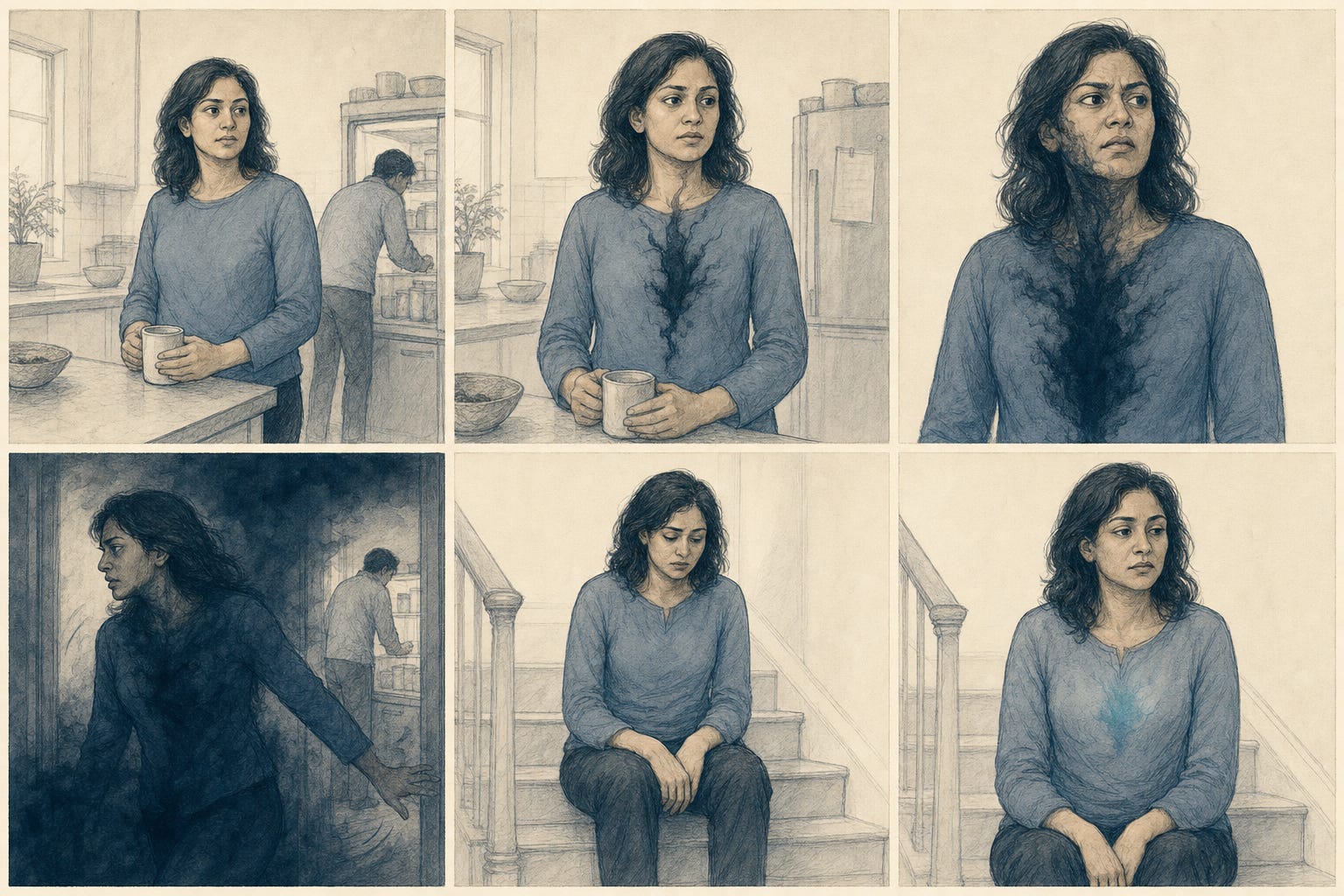
The reframe worth sitting with: in an ADHD flood, that gap often isn’t there.
This is the part people who don’t live it struggle to believe, and the part people who do live it recognise instantly. There is supposed to be a beat. A fraction of a second where the first feeling registers as a feeling, a small hang on, before the body commits to anything. Most people get that beat. It’s where the choosing happens. Naomi doesn’t get it, or gets it so compressed that it’s gone before it’s usable. The shame and the anger arrive close enough to overlap, and by the time either one reaches the part of her that could name it, the anger is already talking, already out of her mouth, because anger recruits the body faster and more completely than shame ever will. It moves at the speed the flood moves. Shame is slower, and by the time it would have surfaced, the shouting has already happened and given her something new to be ashamed of.
She didn’t suppress the shame and choose anger instead. She was never offered the choice. There simply wasn’t a version of that moment where the shame arrived early enough to be dealt with on its own terms.
This is why “just notice what’s underneath the anger” is sound advice and useless instruction at the same time. It asks for a pause that assumes ordinary processing speed. The flood doesn’t leave that pause on the table. Dunkley’s framework isn’t wrong. It’s describing a window that, for a lot of ADHD adults, has already closed by the time anyone could reach it.
What survives isn’t catching it live. It’s going back for it afterwards, on purpose, while the memory is still warm enough to hold.
The useful question is not what made you angry. It’s what would have made you feel small, or exposed, or caught out, in the seconds just before the anger showed up. Naomi’s answer, once she went properly looking, was shame about the mess and a quieter fear underneath it, that the unloaded dishwasher confirmed something she already half-believed about herself and didn’t want confirmed out loud. Neither of those was available to her on the stairs while the adrenaline was still leaving. Both were available a day later, in a chair, if she knew what she was looking for.
This is part of why the CARE grounding tool builds the Reactor profile around exactly this pattern, the anger-first flooding type where the real work happens in the pass back through it rather than in the live moment. If any of this sounds like your own arguments, the Reactor sequence is built to run that retrospective pass properly, with structure, rather than leaving it to whatever you can reconstruct on your own.
For a partner on the receiving end, this changes what the row actually was. A shame response that arrived wearing anger’s clothes, because anger got there first and shame took longer to reach the surface. That doesn’t lift the accountability for the shouting, and Naomi would be the first to say so. What it does is move the useful conversation, out of the argument itself, where nobody can reach anything, and into the quieter time afterwards, when both people can ask what the thing under it actually was. If this is the row you keep having in some form, it might be worth sending this to the person on the other side of it, not as an excuse, but as a starting point for the conversation you keep failing to have while it’s happening.

The experiment, if the dishwasher moment is familiar, is to run that pass back deliberately the next time something small produces a reaction far too big for it. Not in the moment. The moment is lost, and trying to win it live is its own trap. Afterwards, once the flood has fully gone and your hands are steady again, ask what would have made you feel exposed or caught out in the seconds before the anger arrived. Write the answer down even if it’s unflattering. Especially then. The unflattering ones are usually the true ones.
Naomi came back the following week and told me the next argument had been shorter. Not because she’d caught herself in time. She hadn’t. But because she’d stopped being blindsided by her own reaction, and stopped needing to defend it as reasonable once it was over. Knowing what was underneath it took some of the charge out of the top of it.
Next piece in this series comes back to why naming any of this precisely, rather than reaching for “stressed” or “fine,” turns out to depend on a sense most people assume runs automatically, and which, for a lot of us, doesn’t.
If you’ve had the Naomi experience, the argument you found yourself picking apart afterwards to work out what it was actually about, I’d be interested to hear what was underneath it once you went looking.
Anger instead of shame sounds very familiar. I’m interested now in the rest of this series! Thank you
Wow! This is exactly what I’ve been going through. Dishwasher and all. Thank you for writing this