
The Reactor
Why ADHD anger fades in twenty minutes, but the damage doesn’t.


Adam came to his six-month follow-up looking, by most external measures, like someone who had found his footing. The medication was working. His focus had improved. His productivity at work was better than it had been in years.
He sat down and said, “I’ve been told I have an anger problem. I don’t actually feel angry most of the time.”
I believed him on both counts.
What Adam was describing, without having a name for it, is something I’ve seen in clinic often enough to recognise as a distinct pattern. Not a diagnosis. Not a character type. A specific presentation of emotional dysregulation that looks quite different depending on which side of it you’re standing on.
I’ve started calling it the Reactor.
The gap nobody names
When I ask Reactors to describe what actually happens, they tend to describe two separate events.
The first is the outburst itself: a surge, a moment of too much volume or too much feeling or both, directed at someone who happened to be present when the ignition occurred. The Reactor usually knows, in some part of themselves, that the response was disproportionate. Some of them know it while it’s still happening.
The second event is twenty minutes after. The surge dissipates. The nervous system resets. The Reactor looks around at the aftermath and experiences, in quick succession, mortification, genuine remorse, and then something that functions like genuine confusion — because the internal experience of the emotion has moved on, and the external reality has not.
“I can’t hold grudges,” one patient told me. “I literally cannot sustain anger for very long. And yet somehow everyone in my life thinks I’m always angry.”
The people in a Reactor’s life are not wrong. But they are reporting a different experience of the same event. And the distance between those two reports is where most of the relational damage actually lives.
What the Reactor is
The Reactor is one of five patterns I’ve been mapping across clinical work and the published research on ADHD emotional dysregulation. The others, briefly: the Hidden Flooder (contains everything, presents as coping); the Shutter (withdraws so completely that the people around them don’t know whether something has gone wrong); the Ruminator (loops, replays, cannot put the thing down); the Anticipator (already dysregulated before the emotional event arrives, bracing for impact that may never come).
Each pattern looks different. Each needs a different response. That distinction matters because most available advice on ADHD emotional dysregulation treats it as a single problem with a single solution, which is probably why so much of that advice fails so predictably.
The Reactor’s defining characteristic is fast ignition, full intensity, and rapid fade. This isn’t volatility in the colloquial sense, though it can look like it from the outside. It is a specific timing problem: the emotional response arrives before the regulatory system can properly assess what is happening.

Why does ADHD anger come on so fast — and disappear so quickly?
This is the question I hear most often from Reactors, and from their partners. The clinical literature refers to this pattern as emotional dysregulation — what gets described in forums and online communities as ADHD rage. Both labels are pointing at the same mechanism, though neither quite explains it.
In standard emotional processing, there is a brief delay between feeling and response. Long enough to do some regulatory work: assess the situation, consider the context, calibrate the intensity of the response to the actual severity of the event. This delay is largely a prefrontal cortex function.
In ADHD, the prefrontal function is impaired. Not absent, but slower to engage. The emotional signal arrives at full intensity before the context does. By the time the rational processing has caught up with what’s happening, the response has already occurred.
In the ADHD brain, the emotional signal arrives before the regulatory system can assess it. The result is a full-intensity response with no buffering. The surge is neurologically real and typically fades within 15 to 20 minutes—not because the person has regulated themselves through effort, but because the prefrontal cortex eventually catches up to what happened.
The same executive function deficit that affects attention and task completion also affects emotional inhibition. There is no defect in the emotional experience itself. The Reactor feels everything the emotion contains. What is impaired is the pause between feeling and response. That pause is where most people do their regulatory work without noticing it’s even happening.
The brevity of the Reactor’s surge is not evidence of shallow feeling. It is evidence of a different neurological clock.
The shame loop
What happens after the surge is, in many ways, the more clinically significant event.
The Reactor’s outburst ends. The nervous system resets. And then the shame arrives, often at a volume comparable to the original episode. The apology tends to be extensive. Sometimes excessive. The Reactor may explain, re-explain, return to the subject hours later, and check repeatedly whether the other person is alright.
This is not, as it might appear from the outside, remorse modulating into something more calculated. It is a second neurological event: the shame loop, running on the same overloaded system that produced the outburst, trying to complete a regulatory circuit that got cut short.
But here is what the Reactor rarely understands about that loop: it often makes things worse for the person who received the outburst. To be apologised to extensively, repeatedly, and at length can feel like being put in the position of consoling the person who hurt you. The apology becomes its own demand. The person who was on the receiving end of the surge now finds themselves managing the Reactor’s shame.
And it doesn’t resolve the underlying asymmetry.
What partners are actually living with
Adam’s partner, by his account, walked carefully around certain topics. She would pre-emptively soften messages before delivering them. She had told him, more than once, that she never knew which version of him she was going to get.
He found this baffling. From where he sat, his mood was reasonably consistent.
I hear this from couples regularly. The Reactor’s nervous system has a hair-trigger threshold and an efficient reset. That combination means the Reactor genuinely experiences themselves as someone who moves through emotional events quickly, doesn’t hold on to things, and doesn’t bear grudges. And they’re right about that.
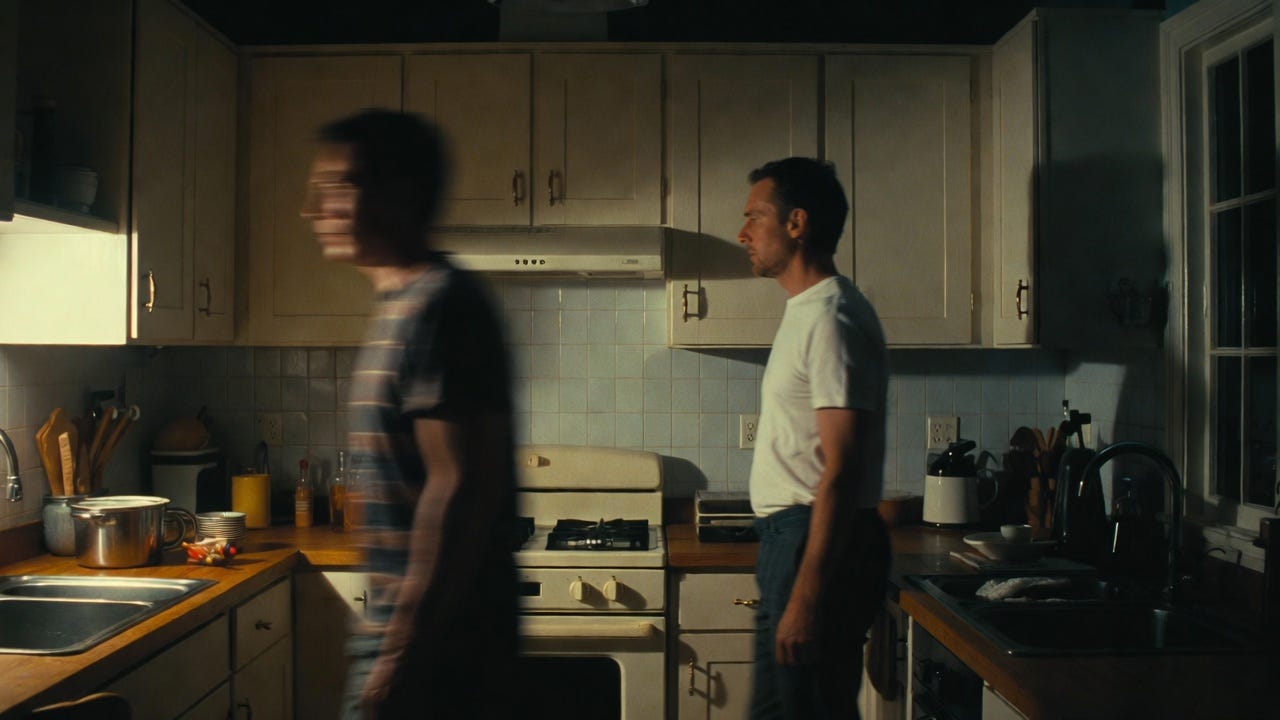
But the people around a Reactor don’t have the same reset. They carry the last outburst into the next ordinary moment. They begin to monitor for early warning signs, to manage their own responses in ways that might reduce the chance of triggering a reaction. Over time, the anticipation of the outburst becomes its own weight, separate from and sometimes heavier than the outburst itself.
Walking on eggshells is not a response to the last explosion. It is a permanent background state, calibrated around the possibility of the next one.
The Reactor forgets. The partner doesn’t. Both are psychologically explicable. Neither is wrong about their own experience. This is not a problem of bad faith on either side. It is a structural mismatch, and it needs understanding before it can be addressed.
What actually changes this
I want to be direct here, because the conventional shape of this section involves a list of strategies and an implicit reassurance that change is available to anyone who wants it enough.
The Reactor cannot will themselves to a longer pause. The nervous system cannot be reasoned with during ignition. That is not a failure of commitment or self-awareness. It is a structural feature of the impairment, and framing it as a character problem is one of the things that keeps Reactors stuck in the shame loop rather than developing any actual capacity to work with the pattern.
What can change is what happens before and after the surge, not within it.
Before the outburst: reducing the frequency of triggers matters more than managing them in the moment. Sleep, cognitive load, sensory environment, and the quality of communication in close relationships about the pattern rather than the individual incidents — these are slow-moving variables, but they are moveable ones. The Reactor who understands their own threshold is better positioned than the Reactor who is perpetually surprised by it.
After the outburst: the twenty minutes following the surge are far more clinically accessible than the two seconds during it. What the Reactor does in that window, how they navigate the shame loop, whether they can resist the pressure to over-explain, and how they and the people close to them talk about the pattern rather than the individual episode — this is where most of the practical work actually lives.
I’ve been building a structured framework for exactly this territory. Not a cure for the ignition, but a systematic way of mapping what happens before and after it, and developing a more deliberate response to both. I’ll be sharing more about that very shortly.
A note on names
Adam asked me, near the end of the session, whether there was a name for what he’d been describing.
There is now.
The Reactor isn’t a fixed identity. It isn’t a diagnostic category. It is a pattern — one that makes a different kind of sense once the neurology behind it becomes visible, and one that looks quite different depending on which side of it you’re standing on.
If you’ve spent time on the Reactor side of this, this piece is for you. If you’ve been the one waiting for them to register what happened, it’s for you too. Most people who recognise this pattern immediately think of one other person who needs to read it.
Naming the pattern doesn’t close the gap. But it does mean both people are finally talking about the same thing.
The Hidden Flooder — the pattern that contains everything and presents as coping — was the subject of last week’s piece. The Shutter, the Ruminator, and the Anticipator follow in the coming weeks.
The part of this that tends to land differently depending on which side of it you’re on is the shame loop — whether you’re the one caught in it, or the one being apologised to long after you’ve moved on. I’m interested in which version of this is more familiar.
I have also seen this aspect but with far less emphasis on the shame spiral afterwards, and I don't know if this is a general lack of shame or a lack of awareness of how their actions affect their family. Possibly a lack of introspection in some people more than others.
I relate to this as a parent on the receiving end of this, however I have also observed this pattern in my family of origin and as a therapist with youth. This is a nice description of the process and I like that it recognises both sides as a lot of the talk around neurodiversity can lead to yp believing everyone needs to adjust to them, which can lead to increased resentment from others. This approach encourages acceptance and responsibility and gives greater opportunity for relationship building if both parties are open to it