
The ADHD got better. I thought the rest was just me.
Why the emotional storms that survived everything else have a neurological address.


Ralph came back to clinic about six weeks into treatment and told me the medication was working. He could read a report to the end. He had cleared a backlog that had followed him from job to job for the best part of a decade. Meetings held their shape. Then, with his coat already half on and his hand near the door, he mentioned the other thing, the way people mention the thing they actually came to say. His laptop had frozen before a call that morning and he had lost his temper over it, sharp enough that a colleague nearby had gone quiet, and the size of the reaction had stayed with him for the rest of the day. The tablets had not touched that. “The ADHD’s sorted,” he said. “That part’s just me.”
I have heard that sentence, or a close version of it, more often than almost any other in this work. The focus improves. The emotional weather does not. And somewhere in the gap between the two, the patient quietly files one half of themselves under treatment and the other half under character.
What lands in that second category is always the emotional part. The frustration that arrives faster than the thought that might have softened it. The upset that floods in over something small and leaves a residue of shame once it has cleared. The eyes that fill at the wrong moment in a meeting. The reaction that is three sizes too big for the event that set it off. People build a whole identity around this. The short fuse. The sensitive one. The one who takes everything to heart. Most have been hearing some version of it since childhood, long before anyone said the word ADHD out loud, which is exactly why it has the texture of bedrock. It feels like the truth about who they are.
When Ralph reached for the door, he was already running that audit. The short fuse, filed under character. Here is what tends to be missing from that diagnosis.
That belief is expensive. If the storms are simply your character, then every one of them becomes a moral failing, and the only response available to you is to try harder to be a better person. So people apologise for years. They run private audits of their own decency. They treat a neurological event as evidence of a flaw in who they are, and they carry the weight of it everywhere, into work, into their relationships, into the quiet hours afterwards when they lie awake replaying what they said.
I have watched this conclusion settle into people who have every reason to question it. People who are thoughtful, self-aware, clinically literate. The belief that the emotional part is just you is remarkably resistant to evidence, partly because nobody ever hands you the evidence. The diagnosis arrives wrapped in language about attention and focus and organisation. The emotional half rarely gets named at all.
The flooding types, the window of tolerance, the interoception work - those are about recognising and surviving what happens inside a flood. This is about what the established clinical frameworks for emotional regulation assume you can do, and where they quietly break down for a brain like this one.
Russell Barkley, who has spent much of a career on this, argues that emotional dysregulation is a core feature of ADHD itself. He calls it deficient emotional self-regulation. The point is mechanical. The prefrontal systems that let a person hold attention on something dull, hold back an impulse and wait a beat before acting are the same systems that hold a brake between an emotion and its expression. When those systems run short, both functions take the hit. The wandering attention and the oversized reaction come from one place. They were always the same condition.
So when people ask whether the emotional side is part of their ADHD or something separate sitting next to it, the clinical answer is that it is part of the ADHD, and central to it. The same executive systems that regulate attention also regulate the gap between feeling something and acting on it, which is why a brain that struggles to hold focus will so often struggle to hold an emotional brake under pressure. A dose tuned to attention can sharpen the focus and still leave the reactions largely standing - and for many people, it does. Which is why the part you have spent your life filing under personality has a neurological address.
There is something else worth saying here, and it tends not to get said. People manage their ADHD through different routes. For some it is medication. For others it is exercise, or the changes that come with sleep and structure and cutting the load down to something the system can carry. What they often notice is the same shape Ralph noticed. The recognisable symptoms ease - the focus, the restlessness, the scattered attention the diagnosis is written around - while the emotional dysregulation carries on much as before. That gap is the thing people misread as proof the storms are character. It is worth reading differently. When the rest of the system settles, the cognitive load that was consumed by tracking everything at once starts to lift, and the moves that emotional regulation actually requires - noticing a reaction building, pausing before it lands, choosing what comes next - become reachable in a way they were not before. The settling does not regulate the emotion. It builds the pedestal you can finally stand on to do that work.
So I am not going to hand you an excuse here, and I do not want one either. ADHD is real and the storms are neurology, and you are still accountable for what happens in their wake. What changes is where the work goes. You can stop spending it on becoming a fundamentally different person, because that was never the thing that needed solving, and start putting it toward the kind of regulation the brake actually responds to. The apology you owe a colleague still stands. The decade spent apologising for existing does not.
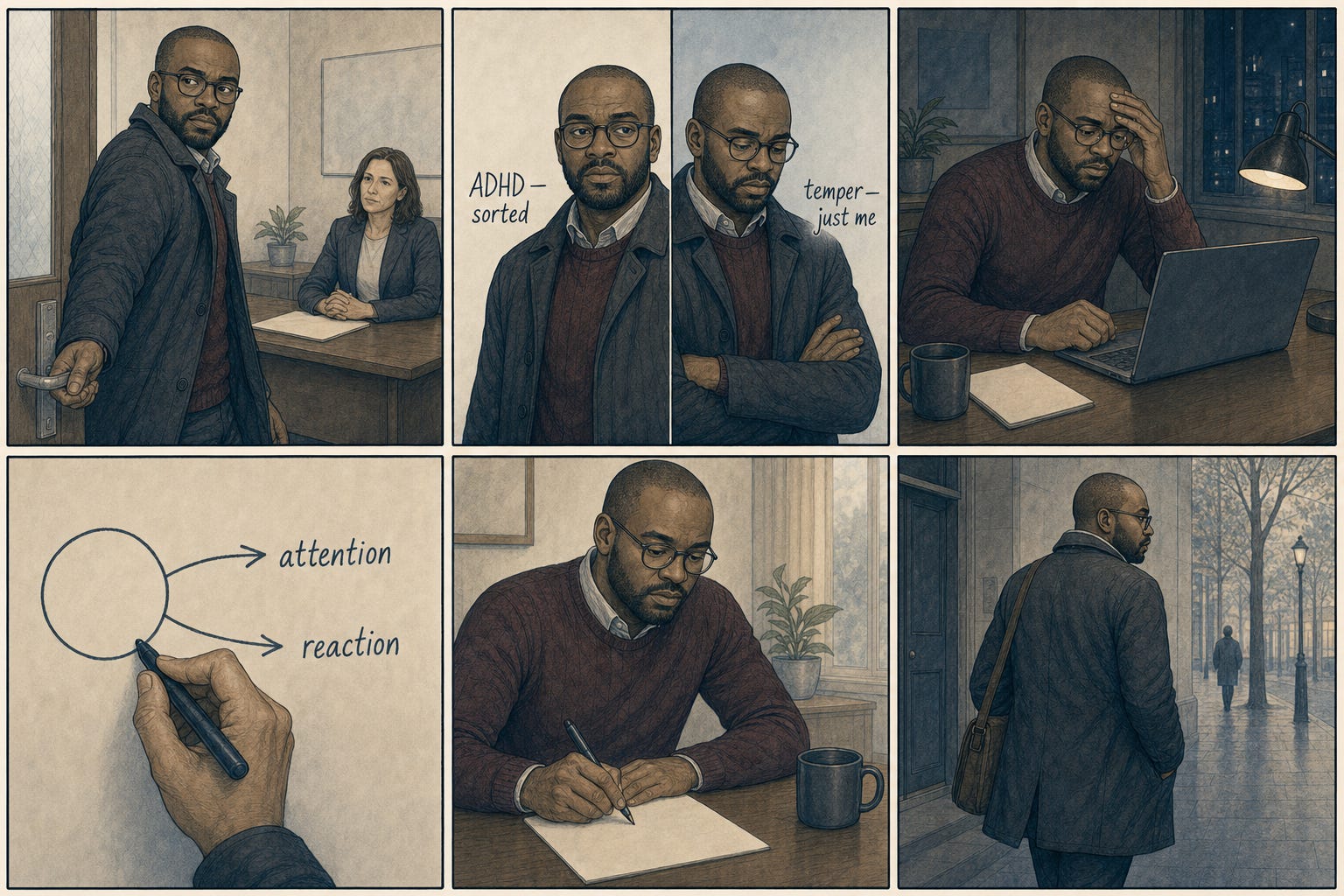
That reframe is load-bearing, and it is not yet the whole structure. The emotional weather has a structure, and structure has leverage points. Once you can see them, you can find the places inside a flood where a brake is still within reach, even in a brain like this one. Over the coming pieces I will take the established frameworks for emotional regulation one at a time, give each its due, and then look honestly at the exact spot where each one quietly assumes a calm, available prefrontal cortex that an ADHD brain in full flood cannot supply.

One practical note for the meantime. When a storm is already building and the thinking brain has gone offline, the moves that still reach you are physiological. I built a small browser tool around that, around the type of flooding you tend to run and a grounding sequence for the moment it actually hits. It sits here if it is useful to you.
https://care.thecontextshift.com/
That shift tends to arrive at a specific moment, and people tend to remember which one it was. Some are still waiting for it. Either way, it belongs in the comments.
The Context Shift is psychoeducational writing. Nothing in it, or in my replies, replaces your own clinical care.
Such a validating post, thankyou for writing it.
Question about the CARE helps. I find I relate quite strongly to each emotional response type, it varies with the circumstances of triggers or the people I am around. Type may also vary over whether I am medicated or not and some responses may even be paired together - I don’t know if that makes sense? Do most people only have one that they predominately experience? Or can it fluctuate?