
The ADHD argument your partner thinks ended at 10pm
The fourth in a series on ADHD emotional flooding types.

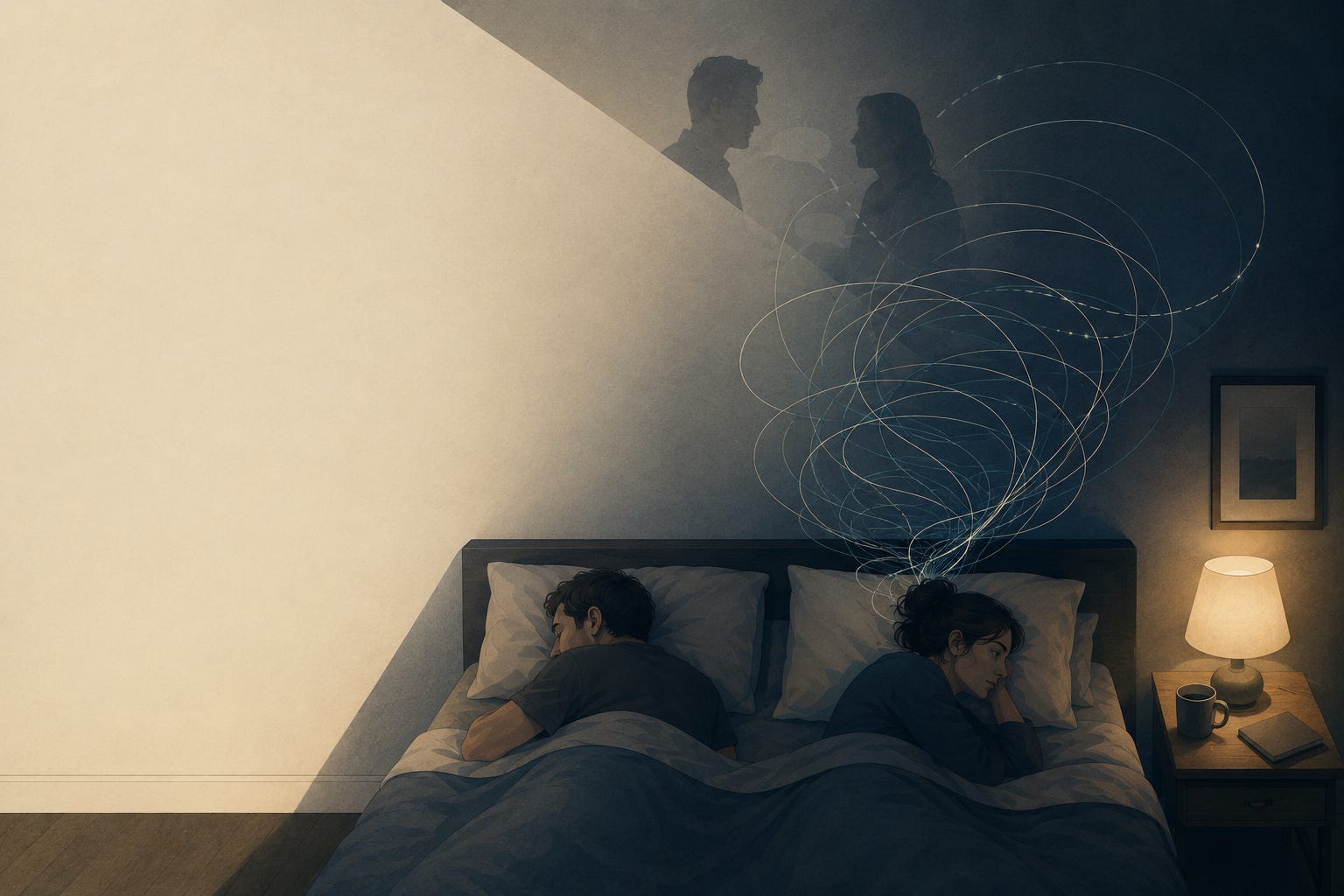
It is 2:47am and Jessica is not asleep.
The argument ended hours ago. She and her partner talked it through in the kitchen, agreed on something, said goodnight. He is asleep. She can hear him. She is lying in the dark running the conversation back, and what she is finding is not what happened at 10pm.
At 10pm, her partner said something about the plans for the weekend. She felt something shift when he said it, a small snag, a sensation of something catching, and then she managed it. Filed it. Continued the conversation. Said the reasonable thing. By the time they agreed to go to bed, the surface was intact.
Now it is 2:47am, and the surface is not the thing she is working with.
She is replaying his exact words. Finding new weight in them. The way he said it. Just the way. What that implies about how he sees her. Whether it connects to something he said three months ago. By 3:30am she has a fully formed position on what the argument really meant, what it reveals about their relationship, what she is going to have to think about.
By morning, her partner will make coffee and ask what she wants to do today. He will have no idea that any of this has happened.
This is the Ruminator.
When Jessica described this to me in clinic, she mentioned it as an aside, the way people name things they have stopped expecting anyone to take seriously. I recognised it immediately. The fourth of the five flooding types I have been describing in this series. Possibly the most privately exhausting of them all.
The Reactor erupts. The Shutter goes offline. Both leave a visible trace. The Ruminator leaves none. The difficult moment passes intact. The flood arrives afterwards, in private, in the dark.
What makes this neurologically distinct is what the replay is actually doing.
The ADHD nervous system does not always flood in real time. In some presentations, there is enough executive function available during the event to manage the surface, to track what is being said, to monitor tone, to produce a regulated response. The flood is deferred. The processing queue fills during the event and runs later, after the prefrontal cortex has stopped standing guard.
What Jessica likely missed during the argument, what most Ruminators miss, is the early accumulation. The interoception deficit that characterises ADHD means the body’s early warning signals are unreliable. The tightening she felt when her partner spoke was there. The load was building. But the signal was not loud enough, or clear enough, to register as something she could act on. The flood did not feel like it was coming. It just arrived.
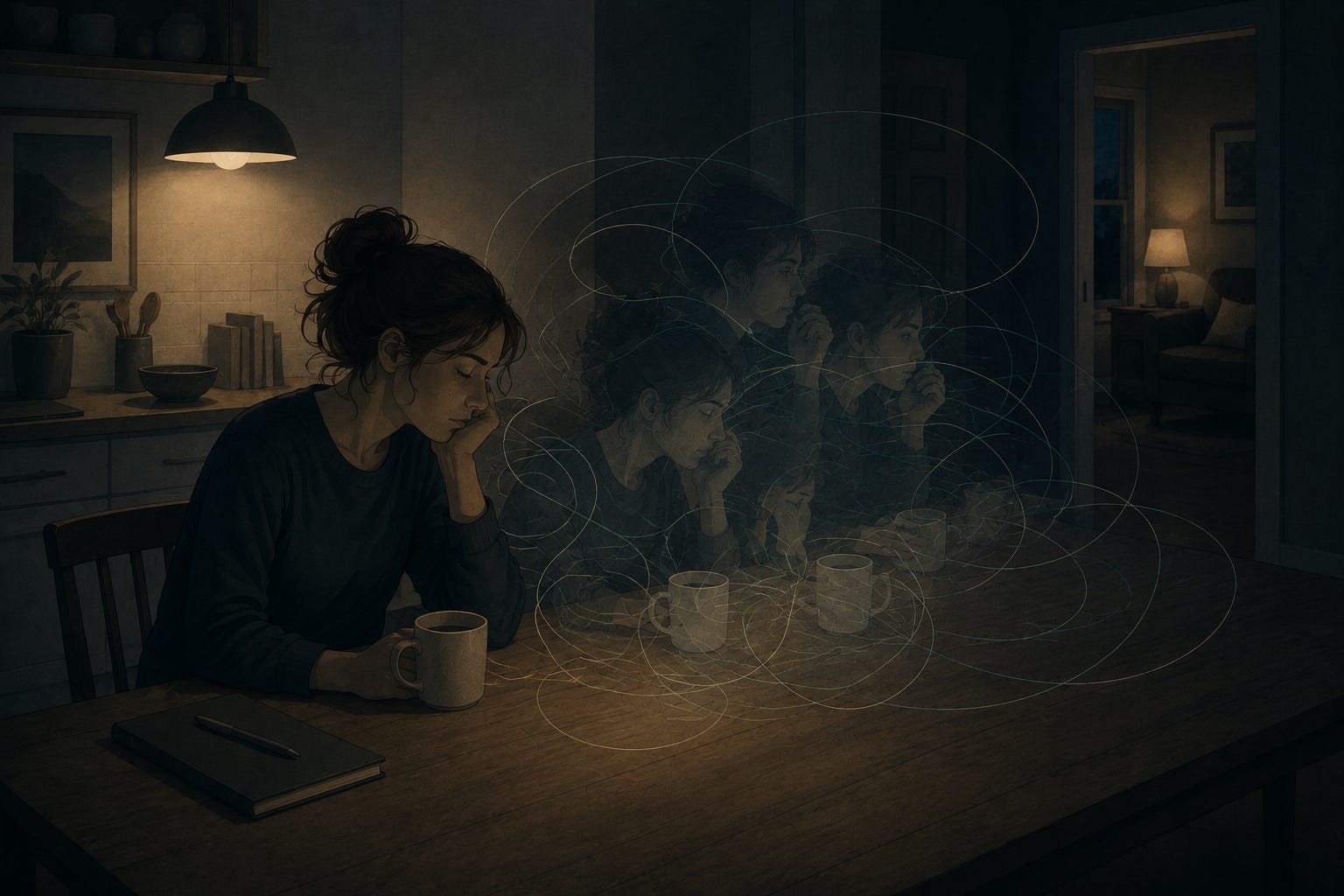
The replay running at 3am is not running on a neutral system. It is running on a nervous system that is now flooded, activated, distressed, on alert, but no longer connected to the original event. The body is in distress. The brain, doing what it always does, generates a story to explain it. But the story is being written retrospectively, by a dysregulated system, without the moderating information that was present at 10pm: her partner’s face, his tone, the context of the room.
The 3am account of what happened is not the same account as the 10pm event. It is harder. More certain of injury. More certain of intent.
I want to be careful here, because the easy version of this misses something important.
The 3am account is not simply wrong. Sometimes the managed surface at 10pm suppressed something real, a genuine hurt that did not yet have language, a pattern Jessica has noticed before and could not name in the moment. The replay occasionally surfaces something true.
From inside a flooded state, there is no reliable way to know which is which. The signal and the noise arrive together, dressed identically. Jessica cannot tell, at 3am, whether what she is feeling is a genuine perception or a dysregulated construction. She will go into the morning carrying both, unable to separate them.
This is the part that partners rarely understand, and that Ruminators rarely articulate. She genuinely cannot calibrate the account she is holding. She is holding two versions of the previous night and has no reliable instrument for telling them apart.
From the outside, the Ruminator’s pattern has a particular quality. The argument ends. Both people go to bed. And then, the next morning, or three days later, or in the middle of an otherwise unrelated conversation, something surfaces.
The partner’s interpretation is almost always the same: she cannot let things go. She agreed it was resolved. She said she was fine. And now here it is again.
The accusation of score-keeping comes from this. Of holding grudges. Of refusing to accept a resolution that was clearly mutual. None of this is how Jessica experiences it. She is not choosing to return to the argument. The argument never fully closed for her, because the processing that would have closed it ran hours after the conversation did, in conditions that did not allow for resolution.
What the partner reads as emotional score-keeping is, more accurately, emotional backlog.

And the backlog accumulates.
This is what distinguishes the Ruminator from the other types in ways that matter over time. The Reactor’s damage is acute, visible, nameable, something both people can point to and address. The Shutter’s is confusing, a disappearance with an eventual return. The Ruminator’s damage is erosive. It does not happen in a single event. It happens across hundreds of small 3am experiences the partner never knew occurred, each one shaping, slightly, how Jessica reads him, their relationship, her own position in it.
There is no obvious rupture to point to. No outburst. No withdrawal. Just a slow drift in how the Ruminator experiences what is, to everyone else, a functioning relationship.
This is why the pattern is particularly hard to interrupt. It never becomes visible enough to address directly.
Jessica knows she replays things. She has been told it is exhausting. Not always by her partner. Sometimes by the part of herself that watches the 3am activity and cannot make it stop. She has tried. She has told herself the argument is over. She has left the room, picked up her phone, read until her eyes closed. The rumination does not respond to those instructions.
It does not respond because it is not a decision. The nervous system is processing on a delay, in the dark, and there is no off switch she can reach from the outside. She has ended up with a nervous system that processes emotional load late, in private, without adequate brakes, and a brain that has filled the gap with the best account it could build from available materials.
The account happens to be the one her partner never heard. The argument he thought ended at 10pm.
The Ruminator’s specific problem is that the replay generates conclusions, and those conclusions get carried into the next day as though they are facts.
The CARE Framework gives the gap a structure. A way of working with both accounts, the 10pm version and the 3am one, without the flooded system being the only thing deciding which one is true.If you recognise this pattern, one thing worth trying: the next time you catch yourself at 3am building the version of the argument your partner never heard, pause before the next conclusion, just long enough to ask one question: am I working from what was said, or from what my nervous system has decided it meant? You will not be able to answer it cleanly. That is the point. The inability to answer it is what the CARE Framework is designed to work with.
Next in the series: the Anticipator, the type who is already flooded before anything has happened.
The pattern I hear most often from Ruminators in clinic is some version of this: I know it was probably nothing. But I cannot make myself believe that at 3am.
If that is familiar, the 3 am construction, the partner’s misread, the accumulation over time, I would find it useful to know which part of this lands.
ASD and AuDHD peeps deal with this too. It’s usually “to keep the peace” because conflict avoidance, “righteous”, and domestic abuse go hand-in-hand (at least the training for women makes that assumption that more peace = less violence).
Also, this rumination cycle eventually gets coded in your system as a type of PTSD somatic loop - at least, in my experience.
This whole thing landed for me! This happens to me ALL THE TIME. I never knew why it happened. Thank you so much for this! It's so incredibly helpful!!!