
The Cost of Composure
Why a manageable day can empty you completely

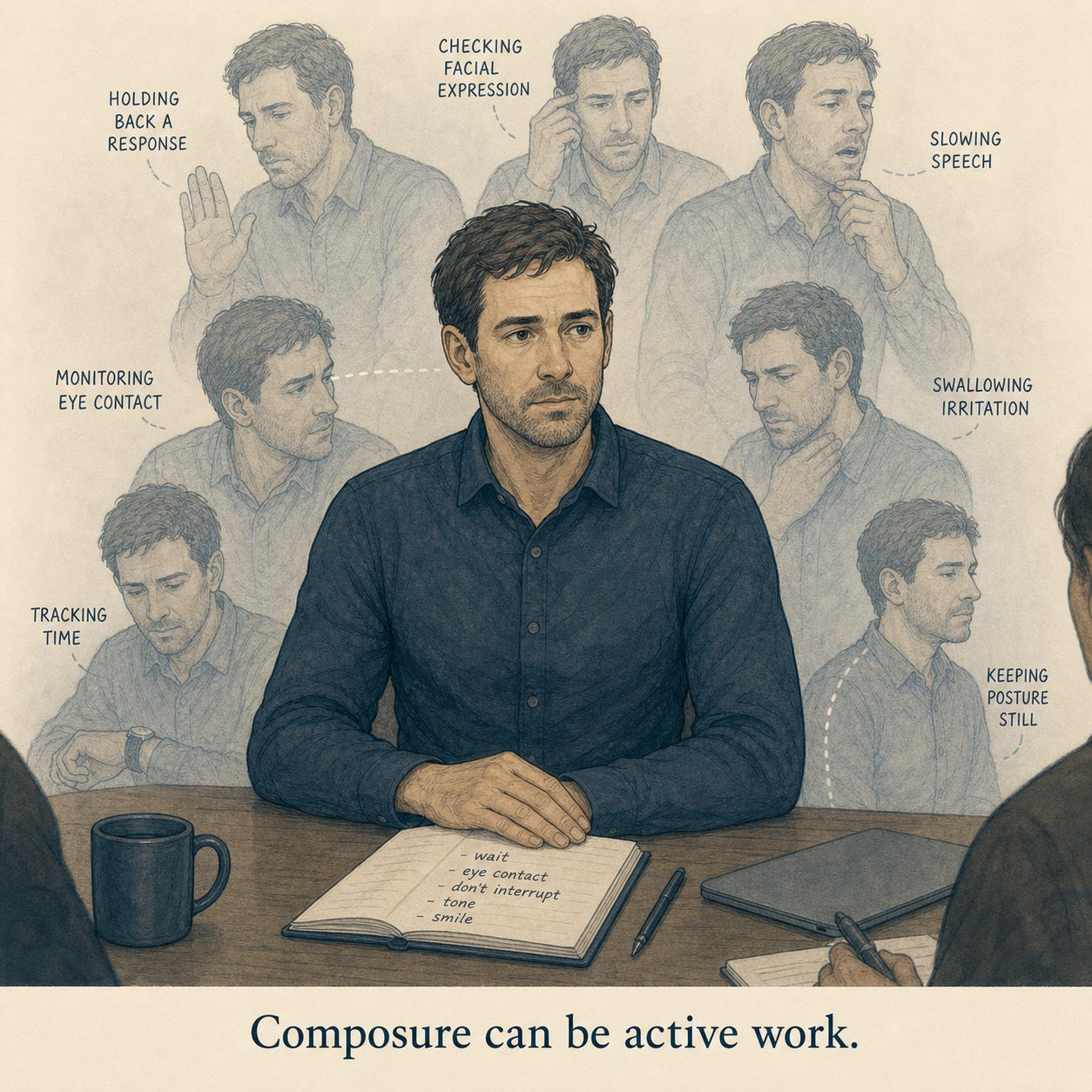
Daniel came to see me three weeks after what he described as a manageable fortnight. The meetings had gone smoothly enough. He had kept it together through two difficult conversations at work. He had replied to emails, met his deadlines, made it through each day without obvious incident.
He arrived in clinic looking exhausted.
He had snapped at his children the evening before over something trivial. He had sat with his partner afterwards unable to explain it. “Nothing went wrong,” he said. “That’s what I can’t understand.”
He had looked, from the outside, like a person who was coping. He had, by his own account, been coping. The fortnight had passed without a visible crisis.
What had not passed was the cost of passing it.
Depleted from doing, depleted from performing
There is a distinction that rarely gets named in ADHD conversations, and I find it matters considerably once patients start recognising this pattern.
Depleted from doing is ordinary tiredness. A heavy workload, a difficult day, too many decisions. The body has worked hard and needs rest. Most recovery guidance addresses this kind.
Depleted from performing is something different. It is the cost of sustained self-regulation: holding reactions back, monitoring impulse, tracking how you appear to others and adjusting in real time. The body is not just doing work. The body is maintaining a version of itself that requires continuous active upkeep (and, unlike the work on the calendar, this maintenance does not appear in anyone’s account of how the day went — including your own).
For adults with ADHD, the gap between those two states is wider than it looks. A nervous system managing ADHD does not have a neutral gear. It is either containing or it is not. Performing regulation, looking regulated, presenting as regulated. This all requires active effort regardless of whether the day was objectively demanding.
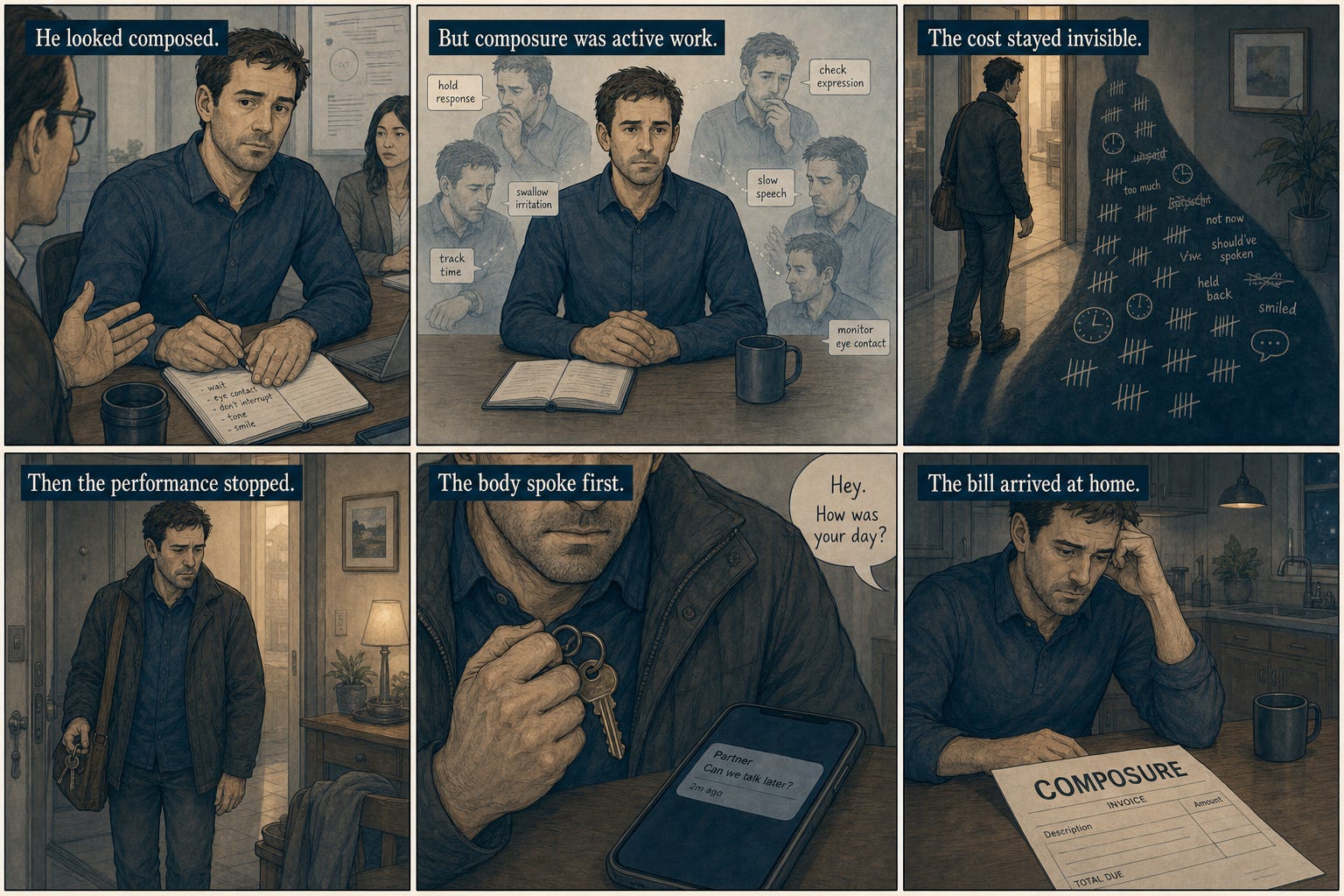
A manageable day is a day in which the cost was invisible.
Where the cost goes
The interoceptive system, the body’s capacity to register its own internal states tends to run with a significant lag in ADHD adults. (If the interoceptive delay is new territory, this piece on why the body’s report arrives late is worth reading alongside this one). The body’s account of what has been happening to it arrives late. Sometimes hours late.
This has a specific consequence for the cost I am describing. The signal that the nervous system has been running at high output all day does not register in real time. By the time it reaches awareness, it has accumulated. It surfaces as flat affect, disproportionate irritability, or a sudden inability to tolerate noise, mess, or small friction in the environment where the performance is finally allowed to stop.
That environment is almost always home. The person it arrives at is almost always the partner, or a child, or the silence.
I have come to think of this collapse, the flooding and shutdown at the end of a day that looked fine — not as something coming from nowhere, but as a report that was delayed. (This is the same mechanism behind the Shutter pattern). The body was keeping score throughout the day. It just was not reporting until it was somewhere safe enough to do so.
Which creates its own problem. The place that should offer recovery becomes the place where the bill arrives.
Why do I feel exhausted when nothing went wrong?
This is the question I hear most often from patients who have been managing their ADHD reasonably well for some time. They have learned to get through the day. What they cannot account for is why getting through the day keeps leaving them empty.
The answer that fits best clinically: the ADHD nervous system does not rest while performing composure. Appearing regulated and being regulated are different physiological states, and the effort of the former accumulates a cost the latter would not.
Allostatic load describes the biological wear accumulated from sustained stress. In an ADHD adult who has spent a working day presenting as composed, be it holding eye contact, managing reactions, pacing speech or suppressing impulse; underneath, the nervous system has been running at high output even when the external picture looked unremarkable. The interoceptive delay means this cost does not register in real time. It arrives in the evening as flat affect, disproportionate irritability, or shutdown in the environments where the performance was finally allowed to stop.
At the level the body was working, the day had a cost the calendar never showed. The collapse is the report arriving late.
And the practical implication that follows: the recovery required is not rest from output. It is rest from performance. Those are different states, and treating one with what helps the other, such as less activity, an early night or a quiet evening, tends not to address what is actually depleted.
What rest from performance looks like
Rest from output means not doing things. Rest from performance means removing the requirement to monitor and adjust the self.
The tools designed for top-down regulation (mindfulness practices, breathing techniques, cognitive reframing) tend to struggle here, for reasons I examined in this piece). They ask the nervous system to regulate itself using exactly the same machinery it has been running all day. What tends to help more is bottom-up: movement, sensory change, physical rest, or simply being somewhere the performance is not required and the self-monitoring can actually stop.
Some people find that in solitude. Some in physical activity that pulls attention entirely into the body. Some in relationships where they are genuinely, not strategically, allowed to be themselves.
The shutdown and flat affect that follow a manageable day are not evidence that something is broken. They are the beginning of recovery. The problem is that they arrive at the wrong moment, in the wrong place, directed at the wrong person.
Reading the body’s signal earlier in the day changes what is possible. The cost accumulates regardless. The difference is having the information while there is still something to be done with it.
The experiment
Before the usual evening context, perhaps before the conversation about the day, before the news, before whatever the evening routine requires, give yourself 60 seconds attending to the body’s state. What is present right now: what the muscles are holding, what the chest feels like, what the actual level of activation is, separate from the story of whether the day was demanding.
The cost is set. What changes is what happens next.
Daniel came back six weeks later. He had not resolved the pattern, but he had started to name it: the managed week, the delayed report, the evening that belonged to the accumulation rather than to the small thing that arrived at the wrong moment. “I still get flooded,” he said. “But I’m less surprised by it now.” In my experience, that is usually where things start to shift.
The pattern I hear most consistently from patients who start naming this is that the collapse tends to arrive at the moment they feel safest. Which is usually the first moment all day that the performance was finally allowed to stop.
The person it arrives at tends to be the one who was never told they were receiving it.
Dr Ketan Bhatt
The Context Shift is psychoeducational writing. Nothing in it, or in my replies, replaces your own clinical care.
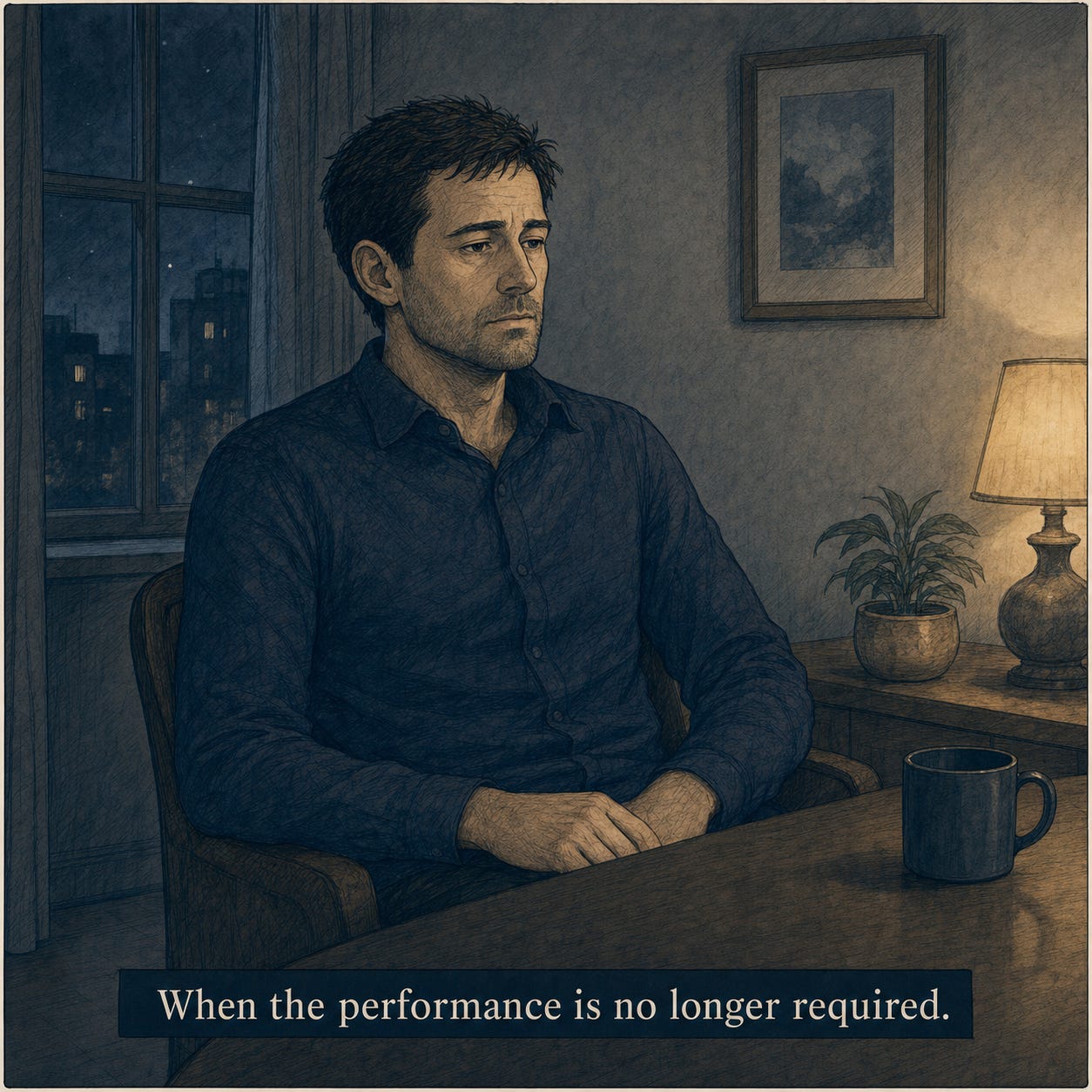
If the day left you feeling like this and you are looking for somewhere to start, the CARE framework’s Context step was built for exactly this gap — a way to check what is actually present in the nervous system before the story about the day gets added.
https://care.thecontextshift.com/
I'm going to print out a couple of your articles, highlight relevant parts, and take them to my next psychiatrist appointment. He's dead set on me not having ADHD, just cognitive effects of depression, and your writings help to explain my emotional dysregulation better than I've ever been able to.