
I had the whole conversation planned. It didn’t get past the first line.
Why the DBT skill you rehearsed perfectly still disappears when you need it.


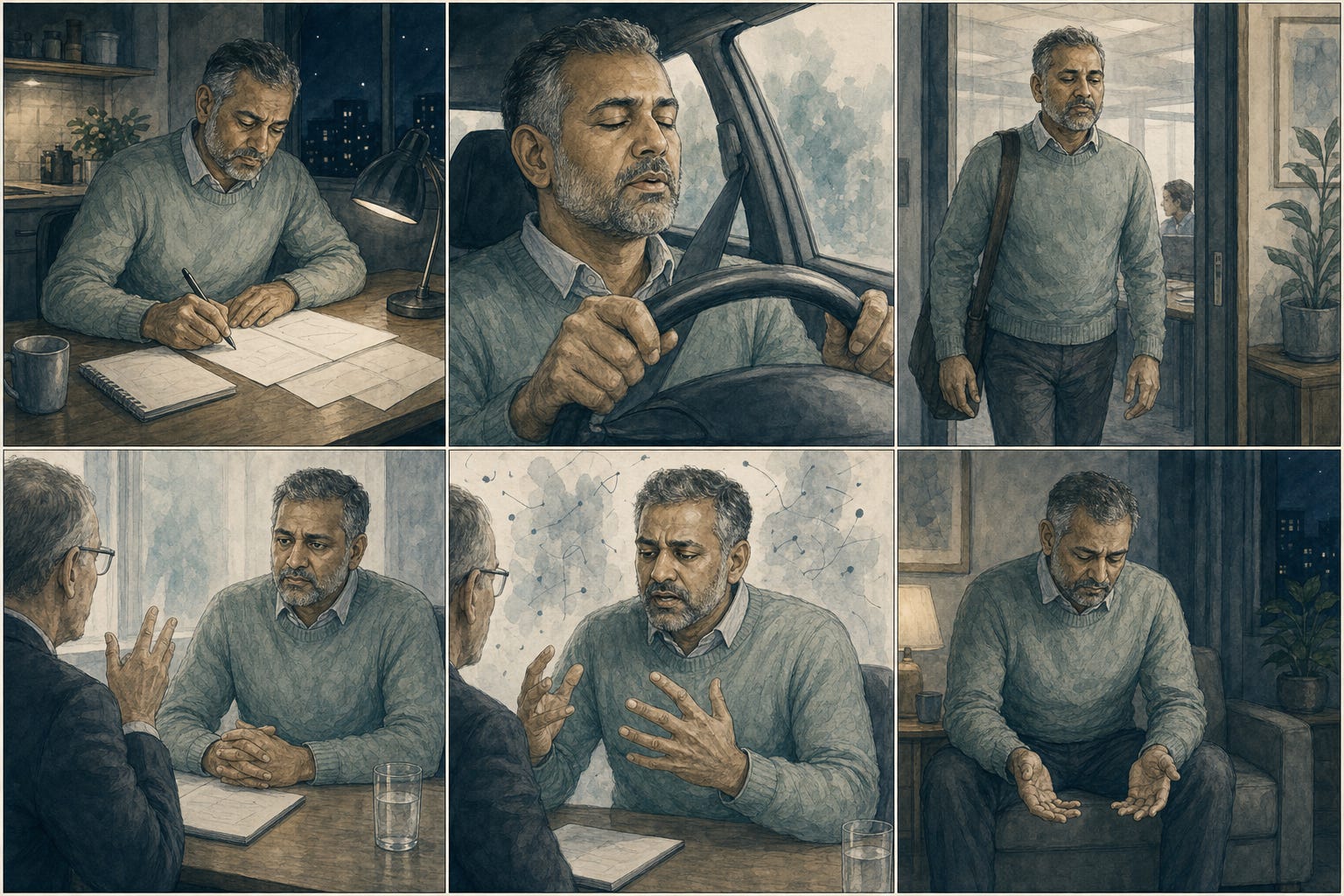
Thomas had written the script out the night before. DEAR MAN, the way his DBT group had taught it: Describe the situation, Express how you feel, Assert what you need, Reinforce why it matters, staying Mindful, Appearing confident, Negotiating if you had to. He’d rehearsed it twice on the drive in, word for word, the way you’d rehearse lines. He was asking his manager for an extension on a project that had slipped for reasons that were partly his and partly not, and he wanted to say it without either grovelling or getting defensive. He had a plan for that. He’d built one.
His manager interrupted him after the second sentence. Not unkindly, just a clarifying question, the kind that happens in every conversation like this. And the script was gone. Not paused, not adjusted. Gone, the way a phone number you were repeating to yourself disappears the second someone asks you your name. What came out instead was three minutes of over-explaining, a mention of his ADHD he hadn’t planned to make, and an offer to work the weekend that he immediately regretted and that solved nothing.
He told me about it the way people tell me about the counting-to-ten failures. Slightly bewildered. “I knew exactly what to say. I’d practised it. It just wasn’t there when I needed it.”
Dialectical Behaviour Therapy takes emotional intensity seriously in a way that a lot of frameworks don’t, and Marsha Linehan built something genuinely comprehensive out of that seriousness. She described three states of mind: Emotion Mind, where feeling drives behaviour; Reasonable Mind, the cool logical end; and Wise Mind, the integration of both, which is where DBT wants you to operate from. Underneath all three sits mindfulness itself, the skill of observing, describing and participating in the present moment without judgement. Linehan treats this as the foundation the other modules are built on, not a single step tucked inside a wider skill. From that foundation comes a full set of modules. Distress tolerance skills for surviving a crisis without making it worse. Emotion regulation skills for reducing vulnerability to intense states in the first place. Interpersonal effectiveness skills, DEAR MAN among them, for asking for things and holding boundaries without losing the relationship. It’s a serious clinical system, and it deserves to be treated as one rather than waved through as background noise before getting to the critique.
Hesslinger and Philipsen adapted DBT skills training for adult ADHD over two decades ago, and their programme already sorts modules partly by cognitive demand. What follows is my own reading of where that adaptation meets the flooding research, not a summary of their protocol, and it’s worth being clear about that distinction before going further. The wider evidence base is worth naming too. DBT-based treatment for adult ADHD carries moderate, mixed support. Zhang and colleagues’ 2026 head-to-head trial found DBT and CBT both improved outcomes over time without DBT establishing non-inferiority, and NICE guidance recommends structured psychological support for adult ADHD without recommending DBT specifically. DBT-for-ADHD is a working adaptation rather than a settled treatment of choice, and the mechanism argument below stands on its own regardless of where that wider debate lands.
Here’s where the critique sits. DBT was built for a population whose central problem is a wall of intense emotion in front of a reasoning mind that, once it can be reached, is intact. The route into Wise Mind runs through steps that need to be held in working memory and executed in sequence. STOP asks you to Stop, Take a step back, Observe, and Proceed mindfully, four moves in order, each depending on the one before it. Check the Facts asks you to hold an interpretation and a set of actual facts side by side, then weigh how likely the feared outcome really is against a fair reading of the evidence, closer to running a small hypothesis test than a simple comparison. DEAR MAN is a script, and a script needs a working memory to hold it while a real, unscripted conversation happens on top of it. Arnsten’s work on the prefrontal cortex under acute stress explains why that working memory disappears exactly when it’s needed most: catecholamine surges rapidly weaken the same prefrontal networks that hold information in mind, while strengthening the more automatic responses running underneath them.
This isn’t only a stress-physiology story. Adults with ADHD often understand a coping plan perfectly well in session and still fail to deploy it in daily life once initiation, working memory, time blindness, stress and competing demands get in the way. That gap between knowing a skill and using it under load runs through the adult ADHD-DBT literature, and Thomas’s evening in the car, script word-perfect, gone within one clarifying question, is that gap in miniature.
Which DBT skills survive an ADHD flood? The physiological ones do, and the ones you’ve already decided on before the flood arrives. TIPP, the temperature, intense exercise, paced breathing and muscle relaxation sequence, works through the body rather than the reasoning mind, so it doesn’t need the part that’s gone offline. Opposite Action survives too, but only if the action has already been chosen while calm. Radical Acceptance belongs on the same side of the ledger. It asks for a stance rather than a construction, no comparison, no multi-step sequence, just a turning towards what is already true, which makes it closer to a posture than a procedure and easier to hold onto once reasoning capacity has gone. Anything that has to be invented, sequenced, or held in mind during the flood asks for a resource the flood has already taken. Anything physiological, or anything pre-decided, doesn’t need that resource at all.

That’s the same line Gross drew between antecedent and response-focused strategies, and DBT turns out to sit across it rather than on one side. STOP, Check the Facts, and DEAR MAN are all response-stage moves dressed up as structure, and the structure doesn’t change where in the sequence they’re being asked for. Opposite Action is different. Decided on beforehand, for a specific known trigger, it stops being an in-the-moment invention and becomes something closer to a rehearsed default, available precisely because nothing had to be built from scratch under load. Thomas’s script failed for the same reason the counting failed in the last piece. It was designed to be produced under conditions where production is the one thing you can’t do.
The physiological route, the one that survives, is where the CARE grounding tool sits as well. The temperature and breathing sequence in TIPP is close to what CARE’s grounding tool runs on, built around knowing your type and having a route through the flood that doesn’t ask anything of the part of your brain that’s already gone. If the in-the-moment flood is where you’re stuck, that’s the place to start:
https://care.thecontextshift.com/
DBT has two halves, and only one of them is built to survive the exact moment it’s usually reached for. Call this the Calm-Window and Storm split. It’s the frame worth keeping, because every skill in your toolkit, DBT or otherwise, sits on one side of it or the other. That split shows up in trial data too. Halmøy and colleagues’ 2022 multicentre RCT found DBT-based group treatment beating treatment as usual on self-reported executive function, ADHD symptoms, depression and quality of life, all genuinely calm-window gains, while showing no significant advantage on emotion dysregulation scores measured straight after treatment, the one outcome closest to what actually happens in the room during a flood. The interpersonal skills, the fact-checking, the mindful pause between stimulus and response, all of that does genuine work in the calmer hours either side of a flood, when there’s a working memory available to run it. Rehearsing DEAR MAN before a difficult conversation, when you’re calm enough to think it through properly, builds something useful. Reaching for it mid-argument asks it to do a job it was never built to do at that moment. Deployment timing decides whether a skill works, not the skill itself.
One caveat worth holding: a DEAR MAN script rehearsed to the point of overlearning starts to behave more like a physiological response than a constructed one, which is the whole point of DBT’s own theory of change. A skill’s place in either pile isn’t fixed forever. It’s where that skill sits for you right now, given how much practice it’s had.
Here’s the experiment, if you want to run one. Take one DBT skill you already know, from a group, a book, or a conversation with a therapist. Ask honestly which half it belongs to. If it needs you to observe, compare, or construct a sentence in real time, it’s a calm-window skill, and its job is to be used before the trigger, not during it. Rehearse it, script it, decide it in advance for a specific recurring situation. If it works through the body rather than the mind, temperature, breath, movement, or through a stance rather than a sequence, it’s a storm skill, and it’s the one you reach for once the window has already shut. Sort the ones you know into those two piles before you need either of them, rather than discovering under pressure which pile a given skill was always in.
Thomas needed to decide, calmly, what he was going to do the next time a conversation went somewhere he hadn’t planned for, rather than trusting that the plan he’d already written would still be there when it mattered. It rarely is. It’s what happens when a skill built for one half of a sequence gets asked to perform in the other, a timing mismatch rather than a personal or clinical failure.
People tend to know immediately which pile a given skill belongs in, once they’ve been asked to sort. Name one of each in the comments: a skill that’s always let you down mid-storm, and one that’s somehow still worked even then. If you know someone who’s watched their own DEAR MAN evaporate mid-conversation, forward this to them before their next one. The next piece in this series looks at what happens when the flood isn’t yours, when you’re the calm one trying to reach someone who’s already gone.
The Context Shift is psychoeducational writing. Nothing in it, or in my replies, replaces your own clinical care.